
Why Your Business Needs Custom Software (2026)
Discover why custom software development delivers better ROI than off-the-shelf solutions. Learn how tailored software solves your unique business challenges and drives growth.
The Generic Software Trap
Every business thinks they’re saving money with off-the-shelf software. Most are wrong.
Here’s what actually happens: You buy a $50/month tool. Then you spend hours adapting your workflow to fit the software. You hire someone to manage workarounds. You lose opportunities because the system can’t do what you need.
The $50 tool ends up costing $5,000/month in hidden expenses.
Let’s talk about when custom software makes sense—and when it doesn’t.
What Is Business Logic?
Business logic is the unique way your company operates. It’s:
- How you calculate prices
- Your approval processes
- The rules that determine customer tiers
- Your specific compliance requirements
- The workflows that make your business yours
Generic software assumes generic business logic. But your competitive advantage lives in the things you do differently.
Example: The Shipping Company
A logistics company we worked with used standard shipping software. The problem? Their competitive edge was a proprietary route optimization algorithm developed over 20 years.
The generic software couldn’t implement it. They were using spreadsheets alongside their “modern” software—the worst of both worlds.
We built them a custom solution → that integrated their algorithm. Result: 23% fuel savings, automated dispatching, and happy drivers.
When Generic Software Works
Let’s be honest: not everything needs custom development.
Use off-the-shelf for:
- Email (Gmail, Outlook)
- Basic accounting (QuickBooks for small business)
- Simple project management (Asana, Trello)
- Standard e-commerce (Shopify for basic stores)
- Team communication (Slack, Teams)
These tools solve common problems that work the same for everyone.
Build custom when:
- Your process IS your competitive advantage
- You’re spending hours on workarounds
- Integration between systems is painful
- You’ve outgrown the limitations
- Compliance requires specific handling
The True Cost of Generic Solutions
Hidden Cost #1: Workarounds
Every workaround has a cost:
- Time spent on manual processes
- Errors from data re-entry
- Training new employees on “how we do it here”
- Lost opportunities while waiting
A client in manufacturing was spending 15 hours/week copying data between systems. At $50/hour burdened cost, that’s $39,000/year in invisible waste.
Hidden Cost #2: Missed Opportunities
Generic software can’t capture your unique value propositions. When a customer has a special request, can your system handle it?
An e-commerce client was losing custom orders because their platform couldn’t handle configurable products. Building a custom solution increased revenue by 34%.
Hidden Cost #3: Integration Nightmares
When your CRM doesn’t talk to your inventory system, humans become the integration layer. That’s expensive, error-prone, and frustrating.
Hidden Cost #4: Scaling Limits
What works for 10 employees often breaks at 50. Generic solutions hit walls that custom software can avoid.
How Custom Software Solves Business Problems
Problem: Complex Pricing
Generic Solution: Price lists, manual overrides, constant errors
Custom Solution: Rules engine that handles:
- Volume discounts
- Customer-specific pricing
- Promotional combinations
- Regional variations
- Real-time margin calculations
Problem: Approval Workflows
Generic Solution: Email chains, lost requests, no visibility
Custom Solution: Automated routing based on:
- Request type
- Dollar amount
- Department
- Urgency level
- Historical patterns
Problem: Customer Experience
Generic Solution: Same experience for everyone
Custom Solution: Personalized journeys based on:
- Purchase history
- Preferences
- Segment
- Lifecycle stage
See how UX design improves business outcomes →
Problem: Reporting
Generic Solution: Export to Excel, build reports manually
Custom Solution: Real-time dashboards showing exactly what you need, when you need it.
The Codebrand Approach
We don’t build software for the sake of technology. We solve business problems.
Step 1: Understand Your Business Logic
Before writing any code, we learn:
- What makes your business unique?
- Where are you wasting time?
- What would 10x improvement look like?
- What’s the real problem behind the symptoms?
Step 2: Design the Right Solution
Sometimes the answer is custom software. Sometimes it’s:
- A better website (web development)
- Improved user experience (UX/UI design)
- Automation of existing tools
- Integration between systems
We recommend what actually solves the problem, not what generates the most revenue.
Step 3: Build Incrementally
We don’t disappear for 6 months and return with a mystery box. Our process:
- Weekly demonstrations
- Continuous feedback
- Adjustments in real-time
- No surprises
Step 4: Ensure Adoption
Software only works if people use it. We focus on:
- Intuitive design
- Proper training
- Documentation
- Ongoing support
Real Results from Real Clients
E-Commerce: 34% Revenue Increase
Problem: Couldn’t handle custom product configurations
Solution: Custom product builder with real-time pricing
Result: Average order value increased 34%, cart abandonment decreased 28%
Learn about our e-commerce solutions →
Professional Services: 15 Hours/Week Saved
Problem: Manual data entry between systems
Solution: Custom integration layer with automated sync
Result: Eliminated data entry, reduced errors by 95%
Manufacturing: $200K Annual Savings
Problem: Spreadsheet-based production planning
Solution: Custom planning system with demand forecasting
Result: 40% reduction in excess inventory, 23% improvement in on-time delivery
How to Know If You Need Custom Software
Answer these questions:
-
Are you paying for software features you don’t use? Generic tools include everything for everyone. You pay for it all.
-
Do you maintain workarounds? If “that’s just how we do it” involves manual processes or spreadsheets, there’s a better way.
-
Is growth limited by your systems? If scaling means “more people doing the same thing,” you have a software problem.
-
Do competitors have capabilities you lack? Custom software can be a competitive advantage.
-
Is your data scattered across systems? Integration issues are symptoms of a larger architectural problem.
If you answered “yes” to 2+ questions, custom software might be worth exploring.
The Investment Question
“How much does custom software cost?”
Honest answer: It depends.
A simple automation might cost $5,000. A complex enterprise system might cost $500,000. The question isn’t “how much” but “what’s the return?”
ROI Framework
Annual Cost of Current Approach:
- Time wasted on workarounds
- Errors and their consequences
- Missed opportunities
- Scaling limitations
= Total Annual Cost

Custom Solution ROI:
(Total Annual Cost × Years) - Development Cost
= Net Value Created
Most of our clients see positive ROI within 12-18 months, with benefits continuing for years.
Beyond Software: The Full Picture
Custom software is part of a larger digital strategy. It works best when combined with:
Strong Branding: Your software should reflect your brand. Explore our branding services →
Great UX Design: The best logic means nothing if users can’t navigate it. See our UX/UI approach →
SEO Strategy: If it’s customer-facing, it needs to be findable. Learn about our SEO services →
Quality Content: Software needs content—help text, emails, notifications. Good writing matters.
Getting Started
Ready to explore whether custom software makes sense for your business?
Option 1: Discovery Call
15-minute conversation about your challenges. No sales pitch, just honest assessment.
Option 2: Process Audit
We analyze your current workflows and identify opportunities. Deliverable: written report with recommendations.
Option 3: Proof of Concept
Small, focused project to demonstrate value before larger investment.
Key Takeaways
- Generic software has hidden costs — workarounds, missed opportunities, integration problems
- Business logic is your competitive advantage — don’t force it into generic boxes
- Custom doesn’t mean expensive — it means appropriate
- ROI matters more than cost — focus on value created
- Start with understanding — technology comes after strategy
Your business is unique. Your software should be too.
Related Articles

AI Agents for Business: Operations Guide 2026
Learn how AI agents are revolutionizing business operations. From customer service to sales automation, discover practical applications and implementation strategies for your company.
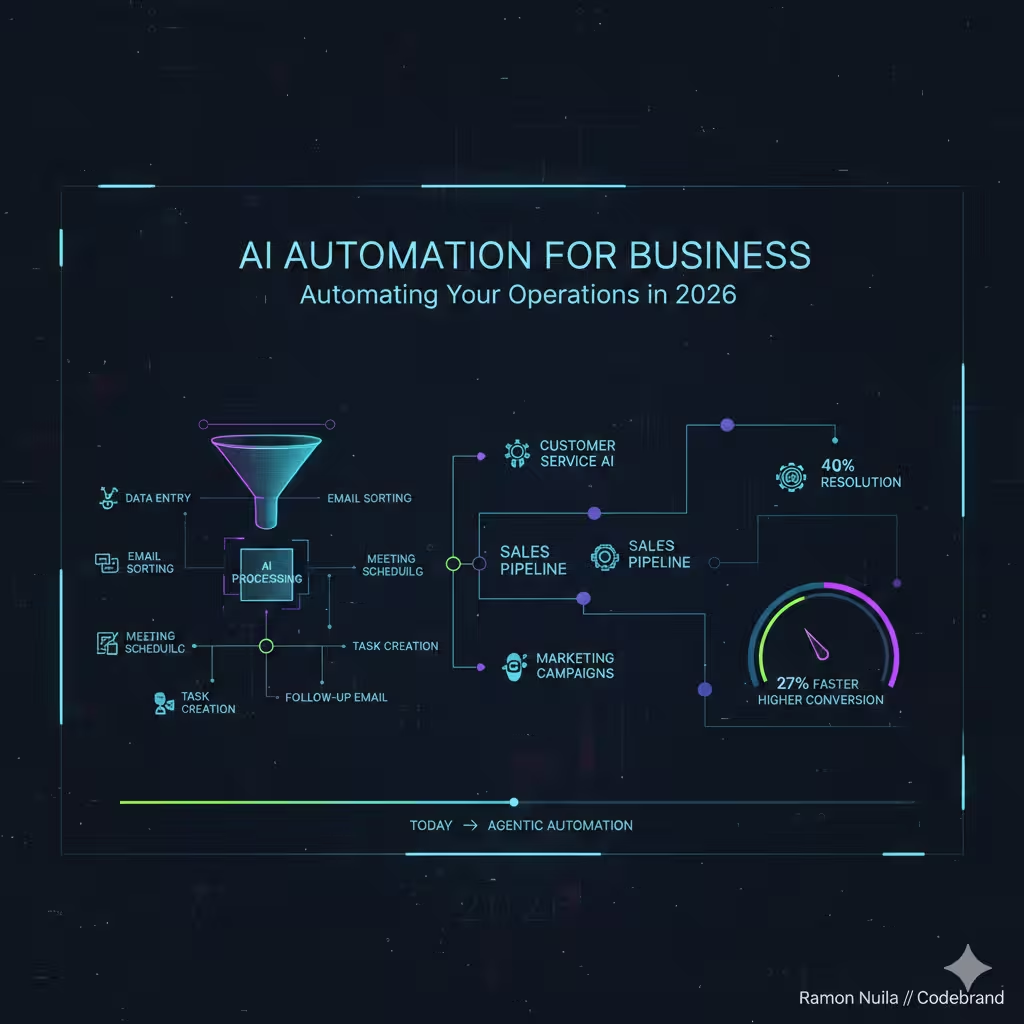
AI Automation for Business: Complete Guide 2026
Learn how to leverage AI automation to streamline business processes, reduce costs, and scale operations. Practical strategies for implementing AI-powered workflows in your company.

WordPress Maintenance: Complete Guide (2026)
Learn how to manage and maintain your WordPress website yourself. Step-by-step SOPs for updating plugins, creating blog posts, building pages with Elementor, and more.

Why Contractors Can't Scale: The Marketing Gap Killing Construction Companies in 2026
Data-driven analysis of why 83% of construction businesses fail within 20 years. Learn how digital marketing, SEO, AI, and UX are transforming contractor growth — backed by real industry statistics from McKinsey, BLS, and BrightLocal.
Do you want to read more articles?
Visit our blog to explore more content on web development, design, and digital marketing.