
How Much Does a Website Cost? Real US Small Business Prices
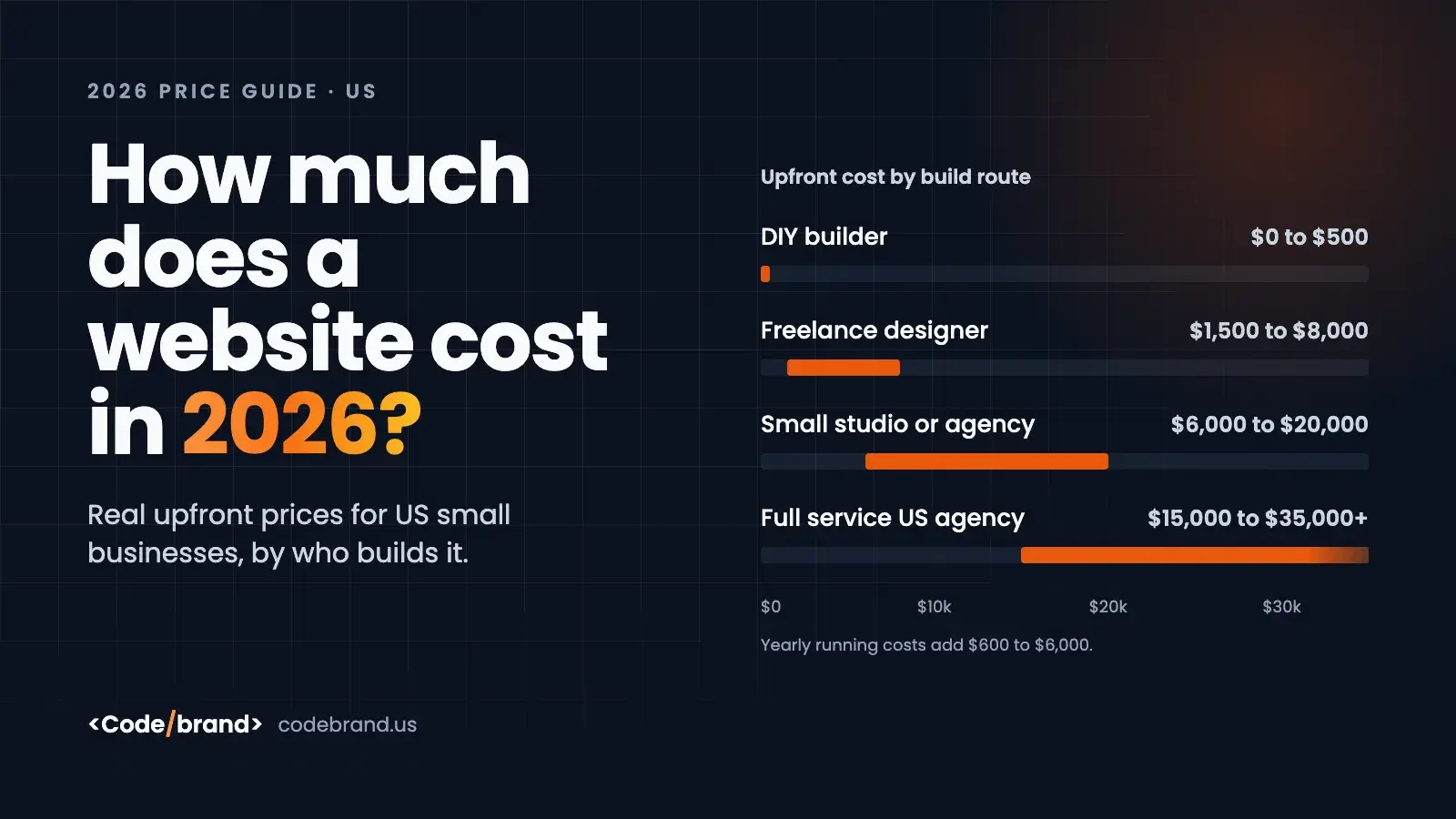
A professional small business website in the US typically costs between $3,000 and $15,000 to build, plus $600 to $6,000 per year to run. A DIY builder site can cost under $500, and a full service agency build starts around $15,000. Codebrand, a nearshore software development company, builds a Landing page for $990 and a Business website of up to 5 pages for $2,490 (see our pricing).
That range is wide because "website" covers very different products. A five page brochure site and a 2,000 product store are not the same purchase. This guide breaks down what you actually pay, what drives the number, and where businesses overspend.
Quick Answer: Website Cost by Build Route
| Build route | Upfront cost | Yearly cost | Best for |
|---|---|---|---|
| DIY builder (Wix, Squarespace, Shopify Basic) | $0 to $500 | $200 to $600 | Testing an idea, very small budgets |
| Freelance designer | $1,500 to $8,000 | $300 to $2,000 | Simple sites with a clear scope |
| Small studio or agency | $6,000 to $20,000 | $1,200 to $6,000 | Lead generation sites, local service businesses |
| Full service US agency | $15,000 to $35,000+ | $3,000 to $12,000 | Complex brands, large content operations |
| Nearshore agency (Latin America) | Typically well below US agency rates for the same scope | Varies by plan | Businesses that want agency process without US agency overhead |
These ranges reflect published pricing guides for the US market. Your quote moves inside the range based on the factors below.
What Actually Drives the Price
1. Number of unique page templates
Page count matters less than template count. Ten service pages that share one layout cost far less than ten pages with ten different layouts. When you request a quote, list your pages and mark which ones share a structure. This one step removes most of the guesswork from pricing.
Typical scope levels:
- Landing page: one page, one goal, usually a lead form or a call.
- Brochure site: five to ten pages. Home, About, Services, Contact, a few service details.
- Lead generation site: ten to thirty pages, location pages, service pages, reviews, quote forms, CRM connection.
- Content site: blog, resource library, categories, search, editorial workflow.
- Ecommerce store: catalog, cart, checkout, payments, shipping, taxes, inventory.
2. Custom design versus template
A tuned template is faster and cheaper. A custom design built in Figma takes more hours, but it gives you a layout made for your offer, your audience and your conversion goals. Most small businesses do well with a structured middle path: a custom design system applied to a proven layout.
3. Functionality
Every feature beyond pages and forms adds cost. Published guides place each added feature in the $500 to $5,000 range. Common examples:
- Online booking and scheduling
- Instant quote calculators
- CRM integration (HubSpot, GoHighLevel, Salesforce)
- Member areas and client portals
- Multi language content
- Payment collection and financing applications
- Custom integrations with internal software
4. Content and copywriting
Content is the most underestimated line item. If you do not have final text, someone has to write it. Professional copywriting runs about $100 to $300 per page. Photography, video and illustration add more. Projects stall more often from missing content than from development problems.
5. Platform choice
The platform affects both the build cost and the yearly cost.
- WordPress: the most flexible option for content and lead generation sites. Large plugin ecosystem, easy editing, wide pool of developers.
- Shopify: the standard for most small and midsize online stores. Fast setup, reliable checkout, strong app ecosystem.
- WooCommerce: a store inside WordPress. Good when content and commerce need to live together.
- Next.js or another custom stack: the right call for web applications, high traffic platforms, custom dashboards and complex integrations. Higher upfront cost, more control.
- Wix and Squarespace: fast to launch, limited when you need custom functionality, advanced SEO control or ownership of the code.
6. Who builds it, and where they are
Labor is the largest part of any website budget. Upwork's rate guide lists intermediate professionals at roughly $25 to $75 per hour and specialized development roles at $75 to $150 or more. US agencies usually bill well above freelancer rates because the price includes project management, design, QA and accountability.
This is why nearshore teams have grown so fast with US companies. You get a full agency process, the same working hours and a lower hourly base. More on that below.
DIY Website Builders: What They Really Cost
Builder plans look cheap. They are, at the start. Current published Squarespace pricing:
| Squarespace plan | Billed annually | Billed monthly |
|---|---|---|
| Basic | $19/month | $25/month |
| Core | $29/month | $39/month |
| Plus | $49/month | $65/month |
| Advanced | $99/month | $139/month |
Shopify's Basic plan sits around $29 to $39 per month depending on billing, and Wix selling plans fall in a similar range. Payment processing fees apply on top.
The real cost of DIY is not the subscription. It is:
- Your time. Ten to forty hours for a first site, more if you redo it.
- Design limits. Templates look like templates. Visitors notice.
- Lock in. You cannot move a Wix or Squarespace site to another host. You rebuild.
- App stacking. Booking, reviews, forms and SEO apps each add a monthly fee.
DIY is a reasonable choice to validate a new business. It is a weak choice once the site needs to generate leads every month.
Freelancer Website Cost
Freelancers typically charge $1,500 to $8,000 for a small business site. Good freelancers deliver strong value. The risks are structural, not personal:
- One person covers design, development, SEO, copy and QA.
- Availability changes. Vacations, illness or a bigger client can pause your project.
- Documentation is often thin, which makes handoffs expensive later.
- Ongoing support depends on that one person staying available.
Hire a freelancer when the scope is simple, the timeline is flexible and you can manage the project yourself.
Agency Website Cost
Small studios charge $6,000 to $20,000. Full service agencies start around $15,000 and go past $35,000 for larger builds. What you pay for:
- Discovery and strategy before design starts
- UX and UI design in Figma, with revision rounds
- Development, testing on real devices, speed optimization
- Technical SEO setup, analytics and conversion tracking
- A project manager and a defined process
- A team that remains available after launch
The tradeoff is overhead. A US agency carries US salaries, offices and sales teams. That cost lands in your quote.
Ecommerce Website Cost
Ecommerce pricing depends on catalog size, integrations and checkout complexity.
- Starter store (under 50 products, standard theme, Shopify or WooCommerce): low to mid four figures with a freelancer or nearshore team.
- Growth store (hundreds of products, custom design, filters, subscriptions, reviews, email automation): five figures at most US agencies.
- Custom commerce (headless setup, ERP or inventory integrations, B2B pricing, multiple warehouses): well into five or six figures.
Budget for monthly apps and payment processing from day one. A store with eight paid apps can carry several hundred dollars per month before any marketing spend.
Yearly and Hidden Costs
The build is a one time cost. The site is not. Plan for these line items every year:
| Item | Typical cost |
|---|---|
| Domain name | $10 to $20 per year |
| Hosting (shared to managed) | $5 to $120 per month |
| SSL certificate | Free to $75 per year, usually included with hosting |
| Premium plugins, themes or apps | $100 to $600 per year |
| Maintenance, updates, backups | $50 to $300 per month |
| Business email (Google Workspace or Microsoft 365) | $6 to $22 per user per month |
A realistic floor for a professionally run small business site is about $600 per year. A lead generation site with managed hosting and monthly updates usually runs $2,500 to $6,000 per year.
One rule protects you here: buy your domain, hosting and paid licenses in your own name. Your developer should configure them, not own them. If a vendor holds your domain or hosting account, you do not fully control your business asset.
The Overlooked Factor: Building for AI Search
This is the line item most quotes still miss, and the one that changes what a website is worth.
Search is no longer only ten blue links. Google AI Overviews, ChatGPT, Perplexity and Gemini now answer questions directly. A Pew Research Center analysis in 2025 found that users who saw a Google AI summary clicked a traditional search result in about 8% of visits, compared to about 15% when no summary appeared. Fewer clicks reach websites. The sites that do get mentioned and cited win a larger share of attention.
Interest in this shift is visible in search data. Google Trends shows US searches for "AI SEO" and "AI Overviews" rising sharply over the last 12 months.
What an AI ready website needs, built in from the start:
- Clean semantic HTML. Proper heading order, real lists and tables, no content trapped in images or sliders.
- Structured data. Schema markup for your organization, services, local business details, reviews and FAQs.
- Direct answers. Each service page should answer the question a buyer asks, in the first lines, in plain language.
- Fast performance. Google's Core Web Vitals targets are a Largest Contentful Paint under 2.5 seconds, Interaction to Next Paint under 200 milliseconds and Cumulative Layout Shift under 0.1.
- Consistent business data. Name, address, phone and services must match across your site, Google Business Profile and directories.
- Crawlable content. AI crawlers and search crawlers need to read your pages without running heavy scripts.
None of this is expensive when it is planned before development. Retrofitting it into a poorly built site often costs more than doing it right the first time. When you compare quotes, ask each vendor how the site will be structured for AI search. A vague answer tells you what you need to know.
AI Website Builders: Do They Make Websites Cheaper?
AI builders can generate a working layout in minutes. They are useful for mockups, internal tools and quick tests. They do not replace:
- A conversion strategy for your specific buyers
- Clean, maintainable code you can extend
- Integrations with your CRM, booking and payment systems
- Technical SEO, accessibility and performance work
- Accountability when something breaks
AI has lowered the cost of the first draft. It has not lowered the cost of a website that consistently produces revenue. Professional teams use AI to work faster, which is part of why well run studios can quote less than they did three years ago.
Nearshore Web Development: The Middle Option US Companies Are Choosing
US companies have been moving development work to Latin America at a steady pace. The reasons are practical:
- Same working hours. Central America works on or close to US Central Time. Meetings happen in your day, not at midnight.
- Agency process, lower base cost. You get discovery, design, development, QA and project management, without US overhead in the price.
- Bilingual teams. Communication in English for your team, Spanish when your market needs it.
- Real collaboration. Live calls, shared Slack channels, same day responses.
Compared to offshore teams on the other side of the world, nearshore development removes the time zone delay that slows down feedback and fixes. Compared to a US agency, it removes a large part of the overhead.
What to verify before you hire any nearshore partner:
- Real portfolio work for US clients, with live URLs.
- Verified reviews on Google or Clutch.
- A fixed price proposal with a written scope, not an open hourly estimate.
- Code ownership transferred to you at the end of the project.
- Domain, hosting and licenses purchased in your name.
- A defined maintenance plan after launch.
How to Get an Accurate Website Quote
Most bad quotes come from vague requests. Send vendors this information and you will get comparable numbers:
- Goal. Leads, sales, bookings, applications or credibility.
- Page list. Every page, with notes on which pages share a layout.
- Features. Forms, booking, payments, CRM, member areas, languages.
- Content status. Who writes text, who provides photos.
- Integrations. CRM, email marketing, accounting, inventory, phone systems.
- Platform preference. Or ask the vendor to recommend one and explain why.
- Timeline and budget range. A range lets vendors propose the right scope instead of guessing.
Then compare proposals on scope, not only on price. A cheap quote that excludes SEO setup, analytics and content entry is not cheaper.
Common Mistakes That Raise Website Costs
- Changing scope mid project. New pages and features after design approval add time and cost. Lock the scope first.
- Choosing a platform you will outgrow. Migrating from a builder to WordPress or Shopify later means paying twice.
- Skipping maintenance. Unpatched plugins and expired licenses lead to security issues and emergency fixes.
- Letting a vendor own your accounts. Recovering a domain or hosting account from a former vendor is slow and stressful.
- Treating SEO as a later phase. Site structure, URLs and schema are cheapest to get right during the build.
- No tracking. Without analytics and conversion tracking, you cannot tell whether the website pays for itself.
So, How Much Should You Budget?
A practical starting point:
- Testing a new idea: DIY builder, under $500 upfront.
- Local service business that needs leads: $3,000 to $10,000 for a professional build, plus $600 to $3,000 per year.
- Growing company with integrations and content: $10,000 to $25,000, plus $2,500 to $6,000 per year.
- Online store: low four figures to start, five figures for custom builds, plus monthly apps and processing.
- Same scope, lower base cost: a nearshore agency with a fixed price proposal.
The right budget is the one that fits your goal. A website that brings in two new clients per month pays for itself quickly. A cheap site that brings in none is the most expensive option.
Frequently Asked Questions
How much does a small business website cost?
Most professionally built small business websites in the US cost between $3,000 and $15,000 to build. DIY builder sites can start under $500, freelance builds run $1,500 to $8,000, and full service agency builds often start around $15,000. Running costs add roughly $600 to $6,000 per year, depending on hosting, maintenance and apps.
How much does a website cost per month?
Running costs usually range from $50 to $500 per month, or about $600 to $6,000 per year. That covers hosting ($5 to $120 per month), maintenance and backups ($50 to $300 per month), premium plugins or apps, and business email. Ecommerce stores often pay more because of apps and payment processing.
Is WordPress cheaper than Shopify?
For content and lead generation sites, WordPress is usually more cost effective and more flexible, thanks to its large plugin ecosystem and developer pool. For online stores, Shopify often costs less to launch and maintain because checkout, payments and security are managed for you. Shopify Basic runs about $29 to $39 per month.
How long does it take to build a website?
A landing page takes one to two weeks, a small business site takes four to eight weeks, and ecommerce or custom builds take two to four months or more. Content readiness is the most common cause of delays, so have your text, photos and page list ready before the project starts.
Should I pay for SEO when I build my website?
Yes. Technical SEO, site structure, schema markup and speed optimization cost the least when planned during the build, and retrofitting them into a finished site often costs more. Today this also covers structure for AI search engines like Google AI Overviews and ChatGPT: semantic HTML, structured data and direct answers.
Is nearshore web development reliable?
It is reliable when you verify the partner. Check live portfolio work for US clients, verified reviews on Google or Clutch, and a fixed price written scope. Confirm that you will own the code, domain and hosting at the end of the project, and that a maintenance plan exists after launch.
Who should own my domain and hosting?
You should. Buy the domain, hosting and paid licenses in your business name and give your developer access to configure them. If a vendor holds your domain or hosting account, recovering it later is slow and stressful, and you do not fully control your business asset. Keeping them in your name protects your company.
Get a Fixed Price Proposal
Codebrand is a nearshore software development company based in San Pedro Sula, Honduras, working on US Central Time with bilingual teams. We design and build websites with Next.js and Payload (WordPress only when a client asks for it), online stores, custom web applications and AI automations for US businesses.
Every project starts with a written scope and a fixed price proposal. Payment is split 50% at the start, 30% at the midpoint, 10% at delivery and 10% held for 15 days. The code passes to you after the final payment. Your domain and hosting stay in your name. Our team configures, builds and maintains the site.
Send us your page list and goals, and we will send you a fixed price proposal within 24 business hours. Request a proposal or contact us: we reply within 4 business hours. Current prices are on our pricing page.
Sources
- Equinode: How Much Does a Small Business Website Cost in the US? (2026)
- Upwork: Hourly Rates by Skill and Experience (2026)
- Squarespace Pricing 2026
- Pew Research Center: Google users are less likely to click on links when an AI summary appears (2025)
- Google web.dev: Core Web Vitals
- Google Trends, United States, last 12 months, terms "AI SEO" and "AI Overviews"
- website cost
- website pricing
- small business
- nearshore
- web development

Ramón Nuila
Software Engineer & Founder · Full Stack Developer, UX/UI designer, and digital strategist.
ProfileDo you want to read more articles?
Visit our blog to explore more content on web development, design, and digital marketing.
Read more articlesRelated Articles

How to Hire a Web Development Agency: Complete Guide
How to hire a web development agency: compare agency types and pricing models, the questions to ask, and the red flags that should end the conversation.

Codebrand vs Freelancers vs Agencies: Honest Comparison
Freelancer, big agency or a boutique software company like Codebrand? An honest breakdown of cost, timeline, team size and when each option makes sense for you.

Why Cheap AI Websites Don't Sell: and What Actually Does
A $99 website 'built by AI in a day' brings no sales or trust. See why 'done in a day' is a red flag and what it takes to build a website that truly works.
Want this done for your business?
Tell us the goal and the budget you have. You get a fixed-price proposal within 24 hours.