
How Small Businesses Get Found by AI Shopping Assistants
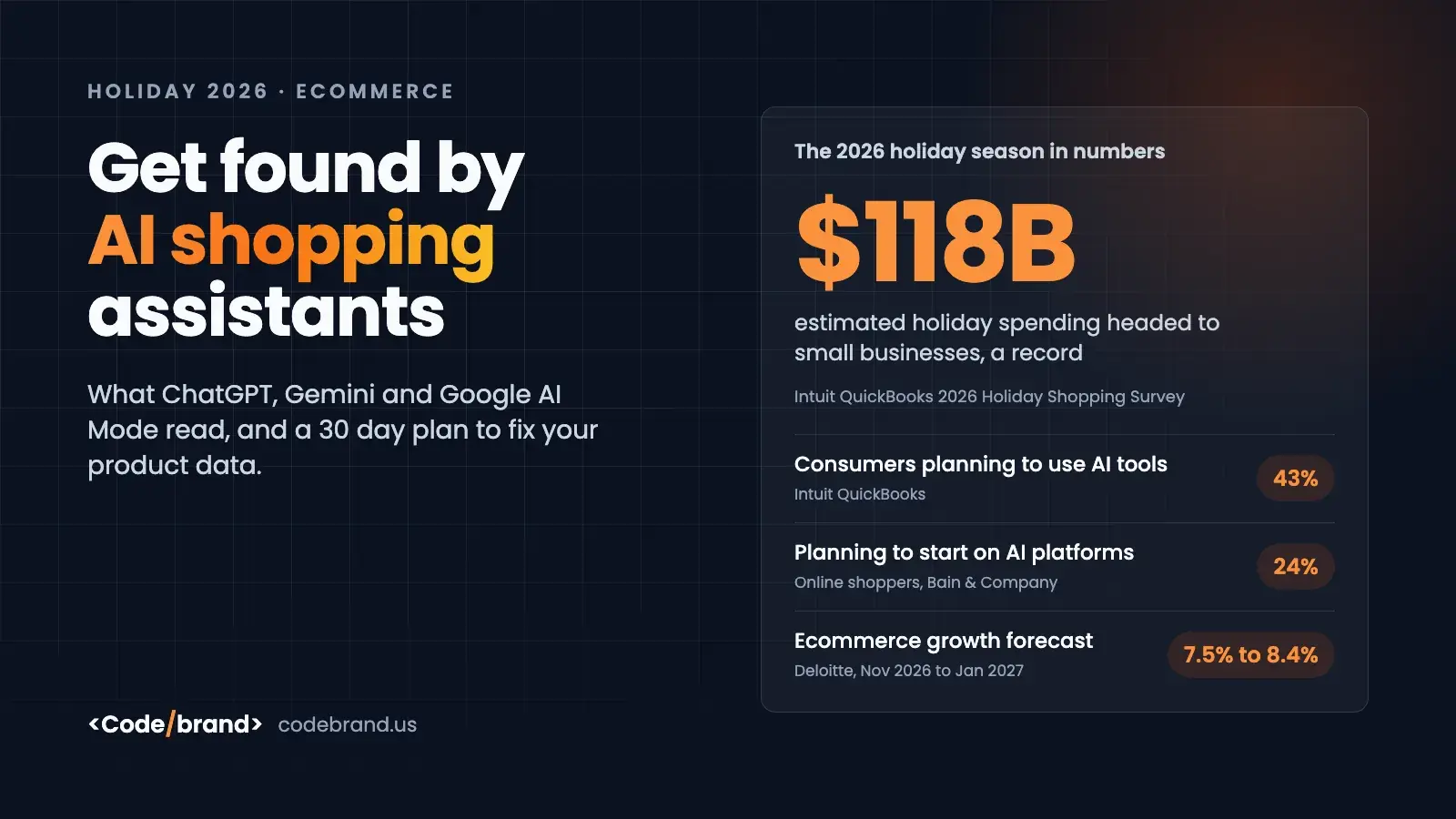
AI shopping assistants find small business products through product data: a Google Merchant Center feed, Product structured data on each product page, and the catalog connections that Shopify and OpenAI run. Fix those before Thanksgiving so ChatGPT, Gemini and Google AI Mode have your prices, stock and details. QuickBooks estimates a record $118 billion in holiday spending will go to small businesses, and 43% of consumers plan to use AI tools.
This guide is for owners of Shopify and WooCommerce stores, including stores in Texas, Florida and California that sell in English and Spanish. It ends with a 30 day plan to finish before the rush.
The Holiday Numbers Small Businesses Should Know
Three sources frame this season. Each figure measures something different, so read the middle column before you repeat one.
| Figure | What it measures | Source |
|---|---|---|
| $118 billion | Estimated holiday spending headed to small businesses, a record, out of $278 billion in total planned holiday spending | Intuit QuickBooks 2026 Holiday Shopping Survey |
| 43% | Consumers who plan to use AI tools this season, up from 39% last year | Intuit QuickBooks 2026 Holiday Shopping Survey |
| 24% | Online shoppers who plan to start their holiday shopping on AI platforms such as Claude, Google Gemini and ChatGPT, up from 17% in 2025 | Bain & Company, September 3, 2026 |
| 60% | Online shoppers who plan to start on retail and brand websites, up from 51% in 2025 | Bain & Company, September 3, 2026 |
| 7.5% to 8.4% | Expected growth in ecommerce sales from November 2026 through January 2027, to between $316.1 billion and $318.9 billion | Deloitte, September 10, 2026 |
QuickBooks reports two different 43% figures. One is the share of consumers who plan to use AI tools. The other is the average share of each shopper's holiday budget going to small businesses, up from 41% in 2025, and it is the basis of the $118 billion estimate. QuickBooks surveyed 6,000 US consumers and 1,002 small business decision makers in August 2026. Bain surveyed more than 1,100 consumers.
The takeaway for a small store: AI is now a real starting point, but far more online shoppers still start on retail and brand websites, so your own product pages carry the weight. Deloitte also expects ecommerce to grow faster than total holiday retail sales, which it forecasts up 4.0% to 4.8%.
How Shoppers Use AI to Find Gifts This Year
Shoppers who use AI mostly use it to research, not to buy. Among them, QuickBooks found that 64% use them to find a better price or discount, 47% to save time on the search, 46% to discover new products or retailers and 39% to get more personalized recommendations. Just 15% have let an AI assistant complete a purchase on their behalf, and half of all shoppers say they would not be comfortable with that at all.
Discovery is the opening for a small business: an assistant that suggests a store the shopper did not know works like a referral. Many small businesses have noticed. QuickBooks found that 46% have already taken steps to be easier to find through AI search or shopping tools, and another 33% plan to.
What changed this year
- Google Universal Cart (October 15). Google began rolling out Universal Cart in the US across Google Search and the Gemini app. Shoppers save products from different retailers in one cart, including from AI Mode, get price drop and restock alerts, and check out with Google Pay at many stores or move the items to the merchant's own cart. Merchants remain the seller of record. The cart is built on the more than 60 billion listings in Google's Shopping Graph.
- ChatGPT and Shopify (March 24). Shopify said products from its merchants become discoverable in ChatGPT by default through Agentic Storefronts. Shoppers complete the purchase in an in app browser that keeps the merchant's checkout settings, or on desktop in a new tab on the merchant's store. The merchant stays the merchant of record.
- Checkout inside AI Mode and Gemini. Google's Merchant Center help describes a checkout button on eligible listings in AI Mode and Gemini, open to select merchants through an early access program. For most small stores, the work this season is the data, not the button.
Picture a hypothetical toy shop in Houston, an illustration and not a client. A parent asks Gemini for a building kit for an eight year old, under $40, that arrives before December 20. Every condition is a data field: price, age range, stock and shipping. A page that hides the age range in a photo gives the assistant less to match.
Product Data AI Assistants Can Read
Where each assistant gets product data
| Assistant | Where product data comes from | What you control |
|---|---|---|
| Google AI Mode and Gemini | Google's Shopping Graph, which Google says holds more than 60 billion listings | A Merchant Center feed plus Product structured data on each page, which Google recommends using together |
| ChatGPT shopping | Agentic Storefronts for Shopify stores, and direct product feeds from approved partners | Agentic Storefronts settings in Shopify, or an application at chatgpt.com/merchants |
| ChatGPT search answers | Pages surfaced by OpenAI's search crawler | Allowing OAI-SearchBot in your robots.txt |
Google says AI Overviews and AI Mode have no additional requirements: a page must be indexed and eligible to show in Search with a snippet. Google also recommends keeping Merchant Center information up to date. Our guide on how to show up in Google AI Mode covers how pages earn citations there.
The fields that matter
Google Merchant Center and OpenAI's product feed spec ask for nearly the same core fields:
| Field | Google Merchant Center | OpenAI product feed |
|---|---|---|
| Unique ID | Required | Required |
| Title | Required, up to 150 characters | Required |
| Description | Required | Required |
| Product page link | Required | Required |
| Main image | Required | Required |
| Price with currency | Required | Required |
| Availability | Required | Required |
| Brand | Required for most new products | Required |
| GTIN | Strongly recommended when the product has one | Optional |
Start with titles. Google asks that a title accurately describe the product and match your landing page. "Hand poured soy candle, cedar and orange, 8 oz" tells an assistant what it is. "Holiday Glow" does not. Put size, color, material and age range in attributes, not only in the description; Google requires some of them in certain cases, such as apparel. Reviews count too: Google says AI Mode shopping answers include details like price, reviews and inventory.
Structured data for products and offers
On the page itself, Google reads Product and Offer markup. For merchant listings it requires a name, an image and an offer with a price above zero and a currency, and it recommends availability, shipping details, a return policy, GTIN, brand, ratings and reviews. Two rules matter most during the season:
- Markup must match the page. Google lists structured data that matches the visible text among its best practices for AI features.
- Feeds must follow stock and sales. OpenAI's feed spec tells merchants to update availability when an item sells out or comes back, and to update the feed when a sale starts or ends.
Spanish product pages for bilingual shoppers
Selling to Spanish speaking shoppers in Miami, Houston or Los Angeles? Merchant Center lists Spanish among its supported languages, and Google says landing pages should be in the same language as the product data. Translate the product page, not just the feed.
What a 7,900 product catalog taught us
In 2024 we built a WooCommerce B2B platform for Laboratory & Tech, a laboratory equipment distributor based in Florida: more than 7,900 products across six categories, a quote only checkout and a custom CRM plugin. These are scope figures from our project record, not results. Two lessons apply to any holiday catalog.
First, structure comes before volume. Before writing code, we defined six top level categories with an attribute structure under them, so the catalog could grow without a rebuild. The result is one multilingual catalog for Latin America and the United States. Attributes defined once and filled the same way for every product are what a feed and an assistant need.
Second, know which path each product takes. Laboratory & Tech sells by quote, so the platform has no cart, no payment and no prices forced into public view, by design. That fits how the business closes deals, and it shows the trade off: Google merchant listings need a price above zero, and WooCommerce prints no product markup for an item with no price, ratings or reviews. A gift shop needs the opposite: a visible price, stock status and shipping promise on every product.
Shopify and WooCommerce Settings to Check Now
Shopify
- Agentic Storefronts. Shopify says Agentic Storefronts reach ChatGPT, Microsoft Copilot, AI Mode in Google Search and the Gemini app, managed centrally from the Shopify Admin, and its Winter '26 Edition announcement says you can toggle each AI platform on or off. Confirm which channels are on.
- Product details. Fill in Vendor, Category, Product type, SKUs and Barcodes for every product and variant. Shopify uses barcodes as identifiers for products and variants.
- Theme markup. Shopify's
structured_dataLiquid filter outputs a schema.orgProductfor products without variants and aProductGroupfor products with variants. Check that your theme uses it, then test a few product pages in Google's Rich Results Test.
WooCommerce
- Core markup. WooCommerce prints
Productstructured data on product pages with the name, description, image, SKU, the GTIN when you fill the "GTIN, UPC, EAN, or ISBN" field, and an offer with price, currency and stock status. Its built in Brands feature adds the brand when a product has one assigned. Core markup includes no shipping details, and it prints nothing at all for a product with no price, ratings or reviews. - Google for WooCommerce. This official extension connects your store to Google Merchant Center and syncs products automatically, with attribute mapping for feed data. WooCommerce asks users to update to version 3.8.1 or later for the move to Google's Merchant API.
- ChatGPT. OpenAI says product feed onboarding is currently available to approved partners, who apply at chatgpt.com/merchants. If ChatGPT matters to your buyers, apply now.
Both platforms: robots.txt
OpenAI says sites that opt out of OAI-SearchBot are not shown in ChatGPT search answers. Check that your robots.txt does not block it, or Googlebot, by accident. Our post on Meta's crawler and robots.txt walks through those rules.
If your store cannot hold clean product data without workarounds, compare the cost of patching it each season with the cost of a rebuild. Our guide to what a website costs covers what online stores cost to build and run.
Social Commerce: Instagram and TikTok as Discovery Channels
AI assistants are not the only new storefront. QuickBooks found that 23% of shoppers say social platforms like Instagram and TikTok are where they are most likely to buy from a small business online this year, up from 20% in 2025 and 16% in 2024.
The work is the same: one clean catalog, sent everywhere.
- Instagram. Shopify's Facebook and Instagram by Meta channel holds a single product catalog for shops on Facebook and Instagram and for ads. Its requirements include products available for direct purchase from your verified domain and an online store that is not in private mode behind a password.
- TikTok. Shopify's TikTok channel syncs your products to TikTok so you can sell directly there, through LIVE shopping, shoppable videos and a product showcase on your profile, while you fulfill orders from the Shopify admin.
- WooCommerce stores. Check whatever feed or plugin sends your catalog to Meta and TikTok, and confirm that prices and stock match the store.
A shopper who sees one price on Instagram and another at checkout has a reason to leave. And if your followers engage in Spanish, link them to Spanish product pages.
A 30 Day Holiday Readiness Plan
Thanksgiving falls on November 26 this year. This plan runs from October 22 to November 20, so every fix is live the week before.
Week 1, October 22 to 28: audit
- Pick the 50 products most likely to sell as gifts.
- Check each one for title, description, price, availability, images, brand, GTIN and key attributes.
- List every product Merchant Center flags with an issue.
Week 2, October 29 to November 4: fix the data
- Fix titles and attributes for the top 50 first, then the rest.
- Test product pages in the Rich Results Test.
- Translate pages and feed entries for Spanish speaking customers.
Week 3, November 5 to 11: connect the channels
- Shopify: review Agentic Storefronts and confirm your products reach Merchant Center.
- WooCommerce: update Google for WooCommerce, check attribute mapping and apply for ChatGPT product feeds.
- Check robots.txt for
OAI-SearchBotandGooglebot, and sync your catalog to Instagram and TikTok.
Week 4, November 12 to 20: holiday details
- Schedule sale prices with start and end dates, so the page, the markup and the feeds change together.
- Publish shipping cutoff dates and your return policy.
- Ask ChatGPT, Gemini and AI Mode the questions your customers ask, and note which stores they suggest.
- Note the date of each change. Google counts AI Mode traffic in the overall search traffic of the Search Console Performance report, within the Web search type, so compare before and after.
Frequently Asked Questions
Do I need Google Merchant Center to show up in AI Mode?
Not strictly. Google says AI Mode has no additional requirements beyond being indexed and eligible for a snippet. For products, though, Google recommends both Product structured data and a Merchant Center feed, because some experiences combine the two, and AI Mode shopping draws on its Shopping Graph. A feed hands Google your whole catalog in one place, so it is worth setting up.
Can ChatGPT show products from a WooCommerce store?
It can, with OpenAI's approval. OpenAI says product feed onboarding in ChatGPT is currently available to approved partners, who apply at chatgpt.com/merchants. Separately, OpenAI says sites that opt out of its search crawler, OAI-SearchBot, are not shown in ChatGPT search answers, so check that your robots.txt allows it. Apply and check both before the holiday traffic arrives.
What is Google Universal Cart?
It is a shopping cart Google began rolling out in the US on October 15, 2026, across Google Search and the Gemini app. Shoppers save products from different retailers, including from AI Mode, get price drop and restock alerts, and check out with Google Pay at many stores or on the merchant's own site. Google says merchants remain the seller of record.
Which product fields matter most to AI shopping assistants?
Start with what Google Merchant Center and OpenAI's product feed both require: a unique ID, title, description, product page link, main image, price with currency and availability. Brand is required by OpenAI and, for most new products, by Google. Add a GTIN when the product has one, then the attributes shoppers ask about, such as size, color and material.
Is it too late to prepare for this holiday season?
No. QuickBooks found that only 13% of shoppers say they have already done most of their holiday shopping or plan to by September, and Deloitte's forecast runs through January 2027. A 30 day plan that fixes your top gift products first, then connects your channels, can be live the week before Thanksgiving.
Get Your Store Ready for AI Shoppers
Codebrand tunes the Shopify and WooCommerce stores US businesses already run and builds new online stores on Next.js and Payload. Our team works from San Pedro Sula, Honduras, on Central Standard Time, in English and Spanish. For the holidays, that means cleaning your product data, fixing your structured data, connecting your catalog to Merchant Center and your sales channels, and building Spanish product pages where your customers need them.
Every engagement is a fixed price proposal built from your budget, and a new online store starts at $4,990 on our pricing page. Tell us about your store and your catalog, and we will send you a proposal. See our ecommerce services
Sources
- Intuit QuickBooks: Holiday Shopping Survey 2026
- Bain & Company: US holiday retail sales set to outpace last year's seasonal growth performance to exceed $1 trillion for the first time (September 3, 2026)
- Deloitte: Deloitte forecasts holiday retail sales to reach $1.70 trillion to $1.71 trillion (September 10, 2026)
- Google: An intelligent new shopping cart (October 15, 2026)
- Shopify: Millions of merchants can sell in AI chats (March 24, 2026)
- Google Merchant Center Help: About the Universal Commerce Protocol and UCP powered checkout
- Google Search Central: Product structured data
- OpenAI: Get started with product feeds
- OpenAI: Overview of OpenAI crawlers
- Google Search Central: AI features and your website
- Google Merchant Center Help: Product data specification
- OpenAI: Product feed reference
- Google: Let AI do the hard parts of your holiday shopping (November 13, 2025)
- Google Search Central: Merchant listing structured data
- Google Merchant Center Help: Supported languages and currencies
- WooCommerce source code: structured data class, version 11.2.1
- Shopify: Introducing Shopify Agentic Storefronts, Winter '26 Edition (December 10, 2025)
- Shopify Help Center: Product details
- Shopify Dev Docs: structured_data Liquid filter
- Google: Rich Results Test
- WooCommerce source code: product inventory fields, version 11.2.1
- WooCommerce source code: Brands class, version 11.2.1
- WooCommerce: Google for WooCommerce documentation
- Shopify Help Center: Facebook and Instagram by Meta requirements
- Shopify Help Center: TikTok sales channel
- US Office of Personnel Management: Federal holidays
- ai shopping
- holiday shopping
- ecommerce
- shopify
- woocommerce
- product data

Ramón Nuila
Software Engineer & Founder · Full Stack Developer, UX/UI designer, and digital strategist.
ProfileDo you want to read more articles?
Visit our blog to explore more content on web development, design, and digital marketing.
Read more articlesRelated Articles
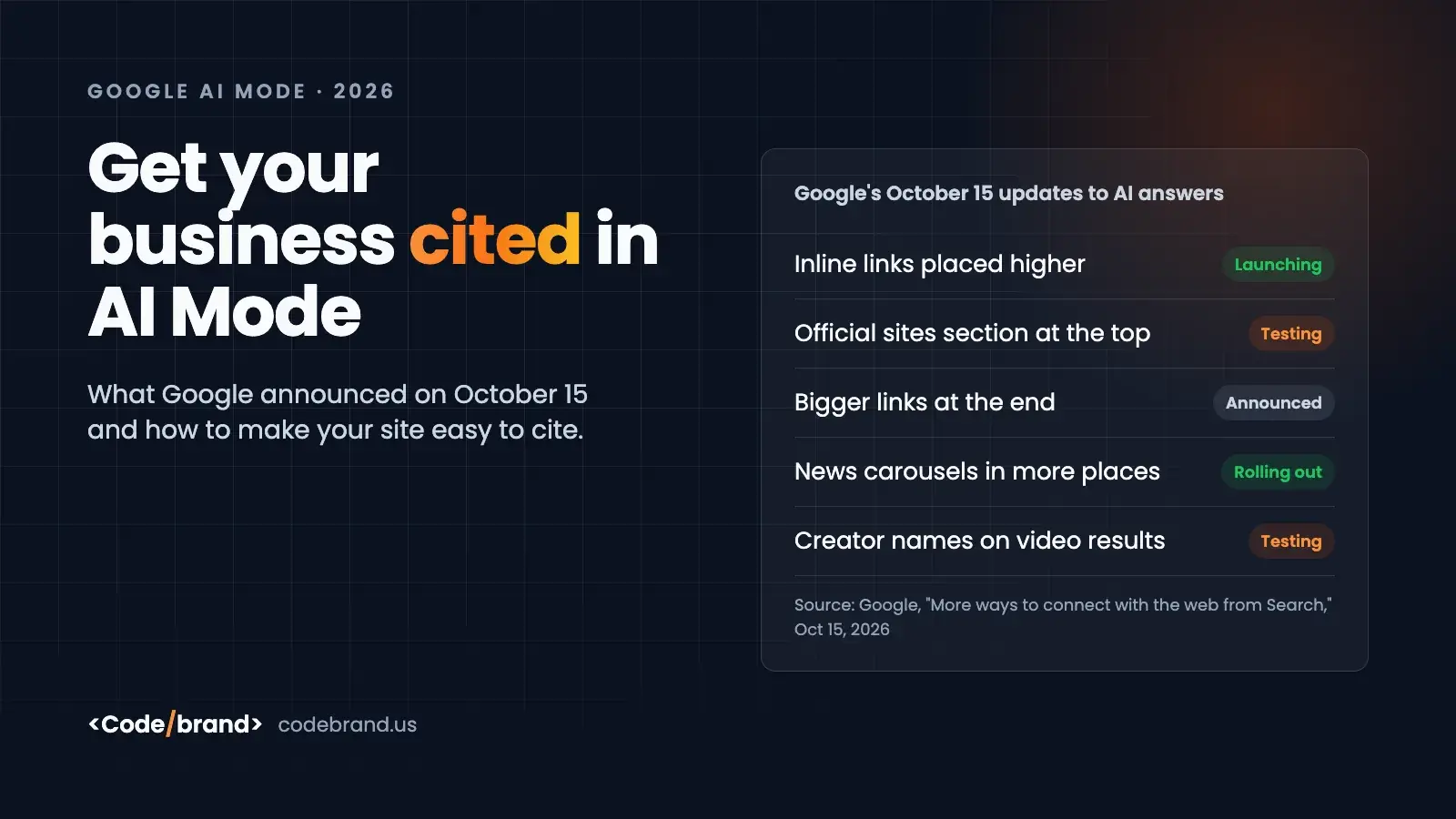
Google AI Mode Now Shows More Links: Get Your Site Cited
Google is adding more links inside AI Mode and AI Overviews. Learn what Google says helps pages get cited, how to structure your site and how to measure it.
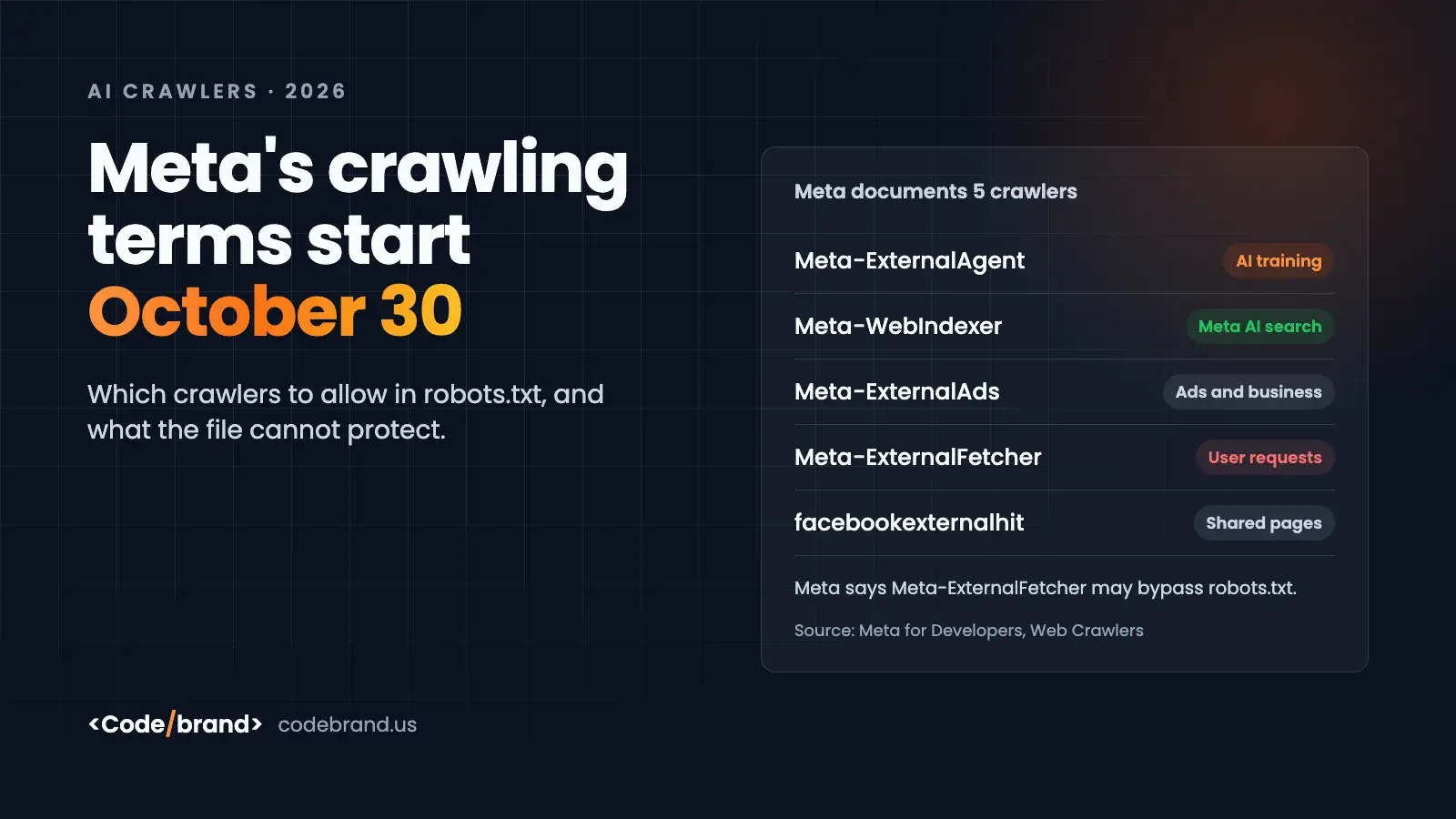
Meta Crawler and robots.txt: What to Set for AI Bots
Meta's new Commercial Terms cover crawling business websites. Learn which Meta, OpenAI, Google and Anthropic crawlers to allow or block in robots.txt.
Why Contractors Can't Scale: The Construction Marketing Gap
Why most construction companies fail to scale: referrals alone stall growth. See the data on SEO, website speed, reviews and AI, plus a roadmap for contractors.
Want this done for your business?
Tell us the goal and the budget you have. You get a fixed-price proposal within 24 hours.