
Google AI Mode Now Shows More Links: Get Your Site Cited
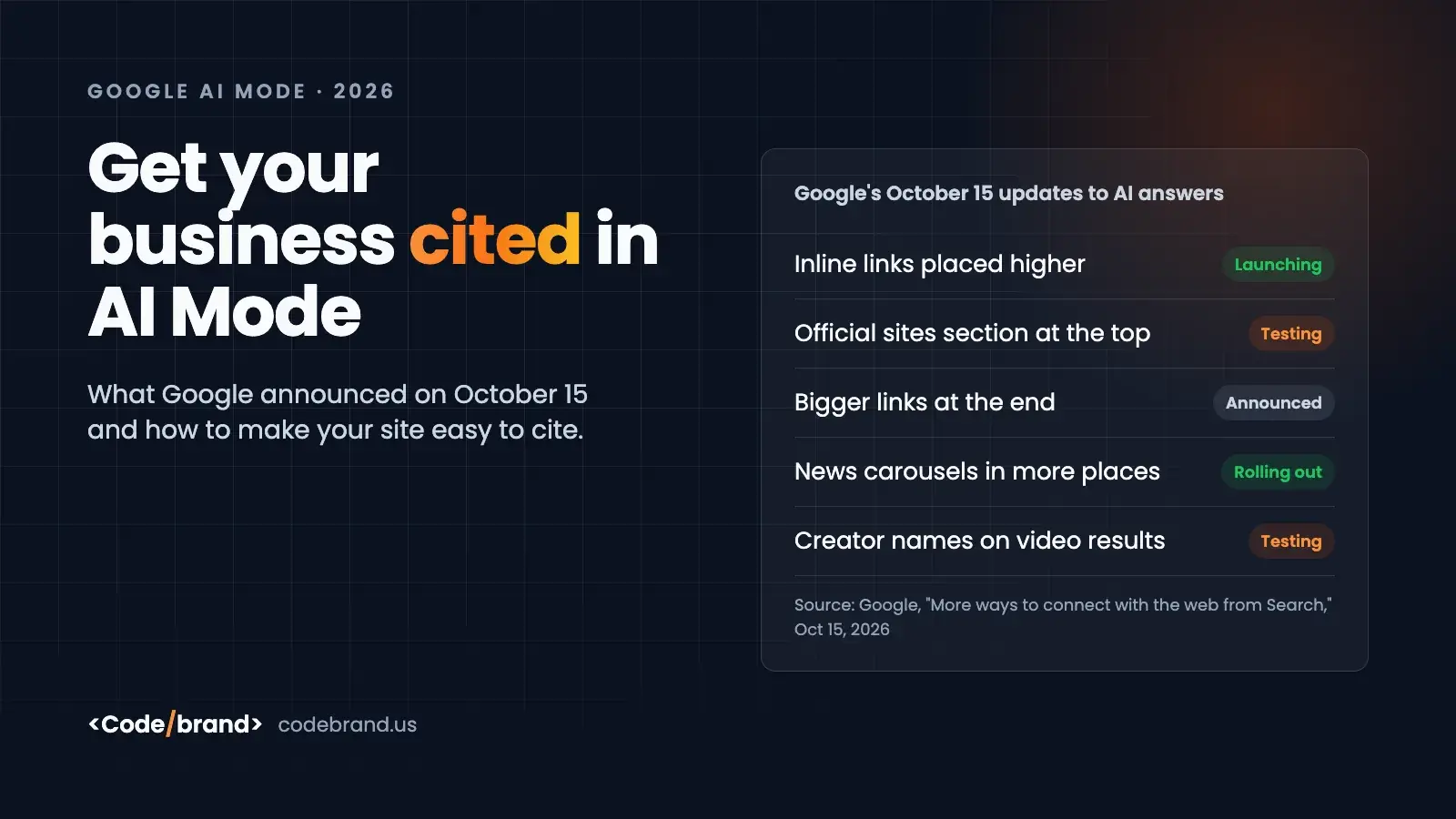
To show up in Google AI Mode, a page must be indexed and eligible to appear with a snippet in regular Search, and your site must stay included in Google's generative AI features, which is the default. There is no special markup or file to add. According to Google's October 15, 2026 announcement, inline links will appear higher in AI answers, and Google will test a section for official sites.
What Google Announced on October 15, 2026
Hema Budaraju, Google's VP of Product Management, listed five updates. Some are launching. Others are tests. The audience is large: AI Mode has passed 1 billion monthly active users, according to Sundar Pichai's May 19 post from Google I/O.
| Update | Status | What it means for your site |
|---|---|---|
| Inline links (links on words inside an answer) shown higher, more often | Launching | Key sources get a clickable link higher in the answer |
| A section at the top for the one or two official places for a task, with context on why each link helps | Testing | Your site could be shown as the place to complete a task or get exact details |
| Links at the end of some answers get thumbnails and a more clickable design | Announced, no status given | Supporting articles get a bigger link |
| News carousels, which highlight each user's Preferred Sources, reach more locations and languages | Rolling out | Mostly for news publishers |
| Clickable creator names on AI Mode video results, linking to Search profiles | Testing | Relevant if you publish video |
Google also said the number of people using its Preferred Sources feature has grown more than 7x since the start of the year. The post gave no click or traffic figures and did not explain how Google decides which site is official. It only said the section builds on how Search already puts a site front and center when people look for it.
Why AI Answers Could Send More Clicks Again
In the same I/O post, Pichai said AI Overviews has more than 2.5 billion monthly active users. One independent study measured what AI summaries do to clicks. A Pew Research Center study of browsing data from 900 US adults in March 2025 found that users who saw an AI summary clicked a traditional search result in 8% of visits, against 15% when no summary appeared. A link inside the summary itself was clicked in just 1% of visits to those pages.
Google reads its data differently. In August 2025, Liz Reid, Google's Head of Search, wrote that total organic click volume to websites had been relatively stable year over year, with slightly more quality clicks, meaning clicks where people do not quickly come back.
Google did not tie its October updates to these numbers. It says showing inline links higher helps make key sources easy to click. It has published no results yet, so treat more clicks as possible, not proven. Either way, a business that is not among an answer's sources has no link to click.
How to Make Your Pages Easy to Cite
Google published its own guide to this on May 15, 2026. Its main point: AI Overviews and AI Mode are rooted in Google's core ranking and quality systems. They retrieve pages from the Search index to ground each answer and can run query fan out, a set of related searches, to find more sources. So the entry ticket is ordinary SEO, plus the eligibility rules above.
Answer the question in the first lines
This is our recommendation from practice, not a Google rule. Open each service page with a direct answer: what you do, for whom, where, and what the result depends on. Google suggests writing for people, with clear sections and headings, and says you do not need to cut pages into chunks for AI. A clear first paragraph is not chunking. It is what a busy buyer needs.
Say something only you can say
Google's guide says unique, useful content will likely matter more for AI search than any other suggestion it makes. It contrasts commodity content, built on common knowledge, with expert and first hand accounts. For example, an HVAC company's "7 ways to lower your energy bill" is commodity. "Why we replace so many capacitors during Houston summers" is not, if it comes from real service tickets.
Make it obvious that your site is the official one
For many tasks, such as booking your service, the official place is your own website. That makes the official sites test worth watching. Google has not said how it picks these sites. What you can control is how clearly your site says who you are:
- One name everywhere. The same business name on your site, Business Profile and social profiles.
- A real contact page. Full address, phone, hours and service areas, as visible text.
- Organization structured data on your home or about page. Google says this markup can help it tell your organization apart from others. Include name, url, logo, address, telephone and
sameAslinks, and for a local business, the most specific LocalBusiness subtype. - One page per service, named the way customers say it, with the action on the page: book, request a quote, check availability.
Treat schema as support and skip the hacks
Google says structured data is not required for generative AI search and there is no special schema.org markup to add. It is still worth using, as long as it matches the visible text. Google also stopped showing FAQ rich results on May 7, 2026, so FAQ markup no longer earns a special display. The same guide says you can ignore llms.txt files, chunking, rewriting pages just for AI and chasing inauthentic mentions.
Do not block the crawler you want to be cited by
Google says Googlebot rules in robots.txt control crawling for Search, while Google-Extended covers AI training and grounding in some of Google's other systems. Leaving AI Overviews and AI Mode is done with the Search generative AI control in Search Console, and costs those impressions and that traffic. For the other AI crawlers and their robots.txt rules, see our guide to Meta's crawler and robots.txt.
How we set this up on codebrand.us
This is how our own site describes Codebrand to search engines. It is a setup, not a claim about rankings or citations.
- One organization, one ID. Every page on our main layout publishes one ProfessionalService node with a fixed
@id,https://www.codebrand.us/#organization, carrying our name, logo, San Pedro Sula address, phone and founding year 2020. Our Honduras pages publish the same@id, and blog posts point to it instead of describing the company again. - Authors are people with pages. When a post's author has a team page, the BlogPosting names that author as a Person whose ID matches the page, such as
/team/ramon-nuila/#person, and that page links the Person back to the organization. - FAQ markup that matches the page. Country pages build their FAQPage markup from the questions and answers a visitor reads on the page.
- Name, address and phone in one file,
src/configs/business.ts. Two layouts must keep literal copies, so a check script compares published addresses against that file. When the owner confirmed our postal code, the old value was wrong in all three copies. - One address, stated honestly. Our city pages name each city as an area served, never as a business address.
Structure like this costs least when planned before development, as our website cost guide explains.
Local Businesses: Google Business Profile and NAP Consistency
Google's AI guide says AI responses can include local business information, and that Business Profiles and Merchant Center feeds can help your services and products appear there. Google's Business Profile help center adds that verified businesses with complete, accurate information are more likely to show in local results, which depend mainly on relevance, distance and how well known a business is.
AI Mode also does legwork for customers. Google's help pages say it can check local availability and pricing by reading the web, filling in forms and, when a business has limited information online, calling the business for the user. If your services, hours and booking details are online, the answer can come from your pages.
A practical NAP (name, address, phone) checklist:
- Use the same name, address and phone on your site, Business Profile, social profiles and directories.
- Keep hours current, including special hours for holidays, and pick the category that matches what you do.
- If you serve customers at their location, list service areas instead of creating an address in each city.
- Reply to reviews. Google says positive reviews and helpful replies can help your business stand out.
- If many of your customers in Texas, Florida or California search in Spanish, publish your key service pages in Spanish with the same name, address and phone, so Google has a page in their language to link.
If you sell products, your Merchant Center feed plays the role for products that your Business Profile plays for services. Our guide to AI shopping assistants and holiday shopping covers product data.
How to Measure AI Mode Traffic (and the Search Console Blind Spot)
Search Console now has a Generative AI performance report. Google announced it on June 3, 2026 and says it reached all websites worldwide as of August 31, 2026. It covers AI Overviews and AI Mode and shows impressions: how often links to your site appeared there, by page, country, device and date.
The blind spot is what it leaves out. It counts impressions, not clicks. Google's documentation lists no filter that separates AI Mode from AI Overviews, and no query view. Clicks from AI features land in the regular Performance report under the Web search type, mixed with all other organic clicks.
| What you want to know | Where to look | The limit |
|---|---|---|
| Are my pages showing in AI answers? | Generative AI performance report, by page | Impressions only, both features combined |
| Do those pages get clicks? | Performance report, Web search type, same pages | AI clicks mixed with regular results |
| Do they produce leads? | Your analytics, conversions by landing page from Google organic | Google documents no AI Mode split |
| Did a customer find us in an AI answer? | A question on your intake form or phone script | Self reported |
Once a month, export the pages from the Generative AI report, compare them with clicks and leads for the same pages, and watch the trend. Be careful with tools that promise AI Mode rankings: Google says no third party tool has access to its internal ranking or AI systems.
Ads in AI Mode: What Google's October Test Means
On Friday, October 16, Google told Search Engine Land it is starting to test ads in AI Mode for users who connect their apps through Personal Intelligence, as Search Engine Roundtable reported on October 19. In March, Google had said there were no ads for people who connected their apps to AI Mode. Ads in AI Mode itself are not new: Google started testing them in May 2025 and said they may appear below and within AI Mode responses. What changed is ads for people who connected their apps.
Personal Intelligence tailors AI Mode answers using a person's Search history and, if they choose, connected apps: Gmail, Google Calendar and Google Photos. Google's help page says ads will not be based directly on the Gmail inbox or the Photos library, but summaries, excerpts and inferences from connected apps may be used to show ads. Google says advertisers get no access to a user's Gmail inbox or Google Photos.
Google Ads documentation says ads can also appear above, below or within AI Overviews, and that ads inside AI Overviews run in English in the US and 11 other countries. Google matches them to the query and to the content of the answer, which it says requires broad match or keywordless targeting such as AI Max for Search.
What this means for a small business:
- Paid and organic share the same answer. A competitor's ad can sit next to the answer that cites you.
- You buy relevance, not a fixed keyword. Inside AI Overviews, ads are matched to the query and the answer.
- An organic citation has no cost per click. Nothing guarantees it, but it does not stop when an ad budget does.
Frequently Asked Questions
How do I get my business cited in Google AI Mode?
Start with what Google requires: your pages must be indexed and eligible to show with a snippet, and your site must stay included in Search generative AI features in Search Console. Then answer the buyer's question in the first lines of each service page, publish details only your business can provide, keep your name, address and phone identical everywhere, and complete your Google Business Profile. Google says indexing and serving are not guaranteed.
Do I need special schema markup or an llms.txt file for AI Mode?
No. Google's May 2026 guide says structured data is not required for its generative AI features and there is no special schema.org markup to add. It also says Google Search ignores llms.txt files, so they neither help nor hurt. Organization and LocalBusiness markup can still help Google understand who you are, as long as the markup matches the visible text on your pages.
Can I see AI Mode traffic in Google Search Console?
Partly. As of August 31, 2026, Google has rolled out a Generative AI performance report to all websites. It shows how often links to your pages appeared in AI Overviews and AI Mode, by page, country, device and date. It reports impressions, not clicks, and lists no way to separate AI Mode from AI Overviews. Clicks sit inside the regular Performance report.
Will ads in AI Mode push my business out of the answers?
Google has not said that ads change which sites an AI answer cites. Ads are sold through the Google Ads auction, while citations come from pages in the Search index. Google began testing ads in AI Mode in May 2025, and on October 16, 2026 it said it is starting to test ads for people who connect apps through Personal Intelligence. A competitor's ad can sit beside an answer that cites you.
Does my Google Business Profile affect AI Mode answers?
It can, according to Google. Its guide to generative AI features says Business Profiles and Merchant Center feeds can help your services and products appear in AI responses and other Search results. Google also says verified businesses with complete and accurate information are more likely to show in local results. When details are limited online, AI Mode may call a business on a customer's behalf.
Get Your Website Ready for AI Search
Codebrand is a software development company founded in 2020 and based in San Pedro Sula, Honduras. We work with US businesses remotely on Central Standard Time, with a bilingual team. Our SEO work starts with a technical audit of crawlability, indexing, structured data and site speed, and then we fix what we find, in English and Spanish when your market needs both. Every engagement is a fixed price proposal built from your budget.
Send us your site and the services that matter most to you. See our SEO service, check our pricing or request a fixed-price proposal: we reply within 4 business hours.
Sources
- Google: More ways to connect with the web from Search (October 15, 2026)
- Google: I/O 2026, Welcome to the agentic Gemini era (May 19, 2026)
- Pew Research Center: Google users are less likely to click on links when an AI summary appears in the results (July 22, 2025)
- Google: AI in Search is driving more queries and higher quality clicks (August 6, 2025)
- Google Search Central: Optimizing your website for generative AI features on Google Search
- Google Search Central: Organization structured data
- Google Search Central: AI features and your website
- Google Search Central: Latest Google Search documentation updates (FAQ rich result removal)
- Search Console Help: Search generative AI control
- Google Business Profile Help: Tips to improve your local ranking on Google
- Google Search Help: Use AI Mode to check local availability and pricing
- Google Search Central Blog: Introducing Search Generative AI performance reports in Search Console (June 3, 2026)
- Search Console Help: Generative AI performance report (Search)
- Search Engine Roundtable: Google Ads Now In AI Mode With Personal Intelligence (October 19, 2026)
- Google: More opportunities for your business on Google Search (May 21, 2025)
- Google Search Help: Connect your Google content apps to get a Search services experience that's tailored to you
- Google Ads Help: About ads and AI Overviews
- google ai mode
- ai overviews
- seo
- structured data
- local seo
- search console

Ramón Nuila
Software Engineer & Founder · Full Stack Developer, UX/UI designer, and digital strategist.
ProfileDo you want to read more articles?
Visit our blog to explore more content on web development, design, and digital marketing.
Read more articlesRelated Articles
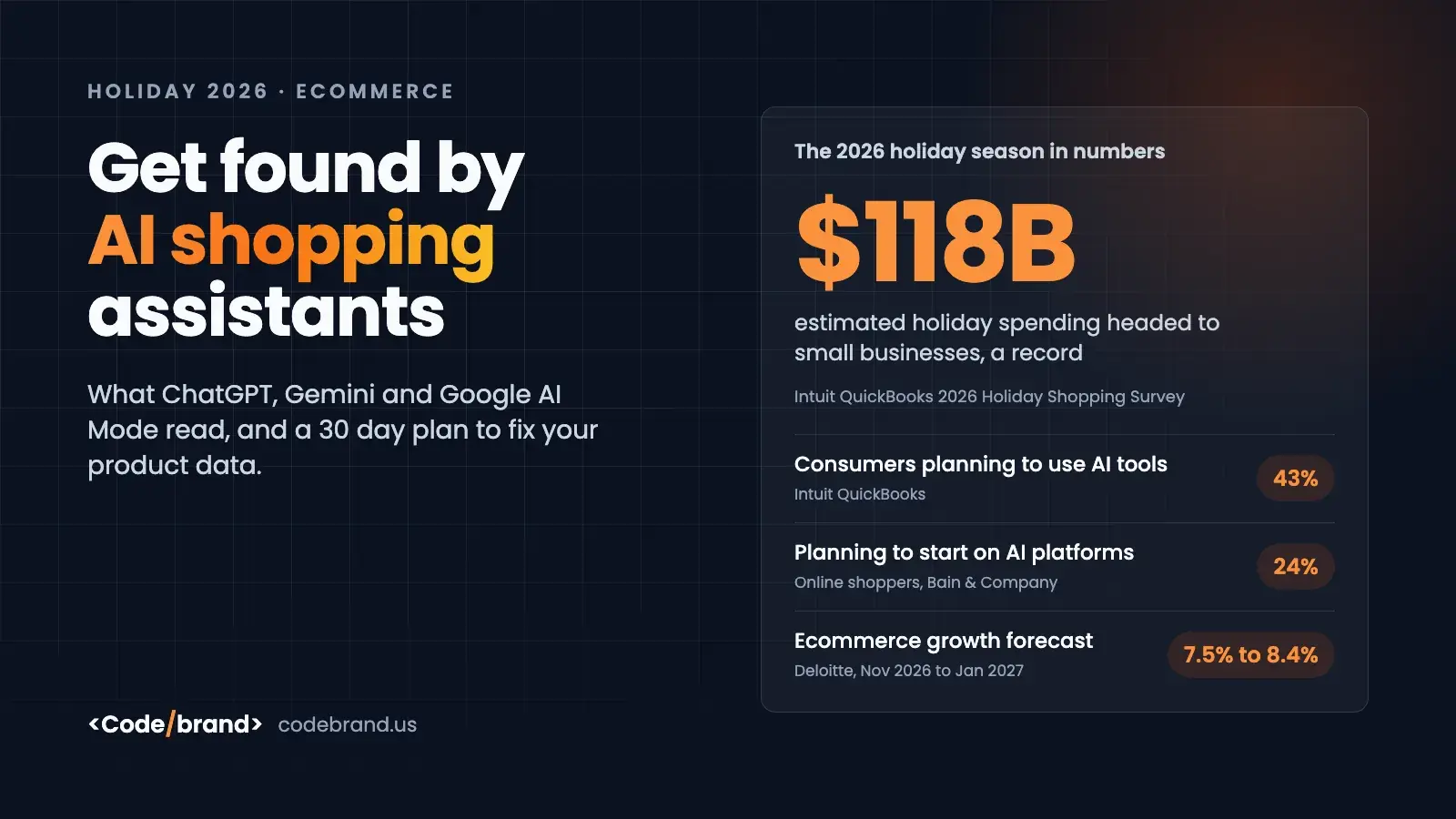
How Small Businesses Get Found by AI Shopping Assistants
QuickBooks estimates a record $118 billion in holiday spending will go to small businesses. Here is how to get your store seen by ChatGPT, Gemini and AI Mode.
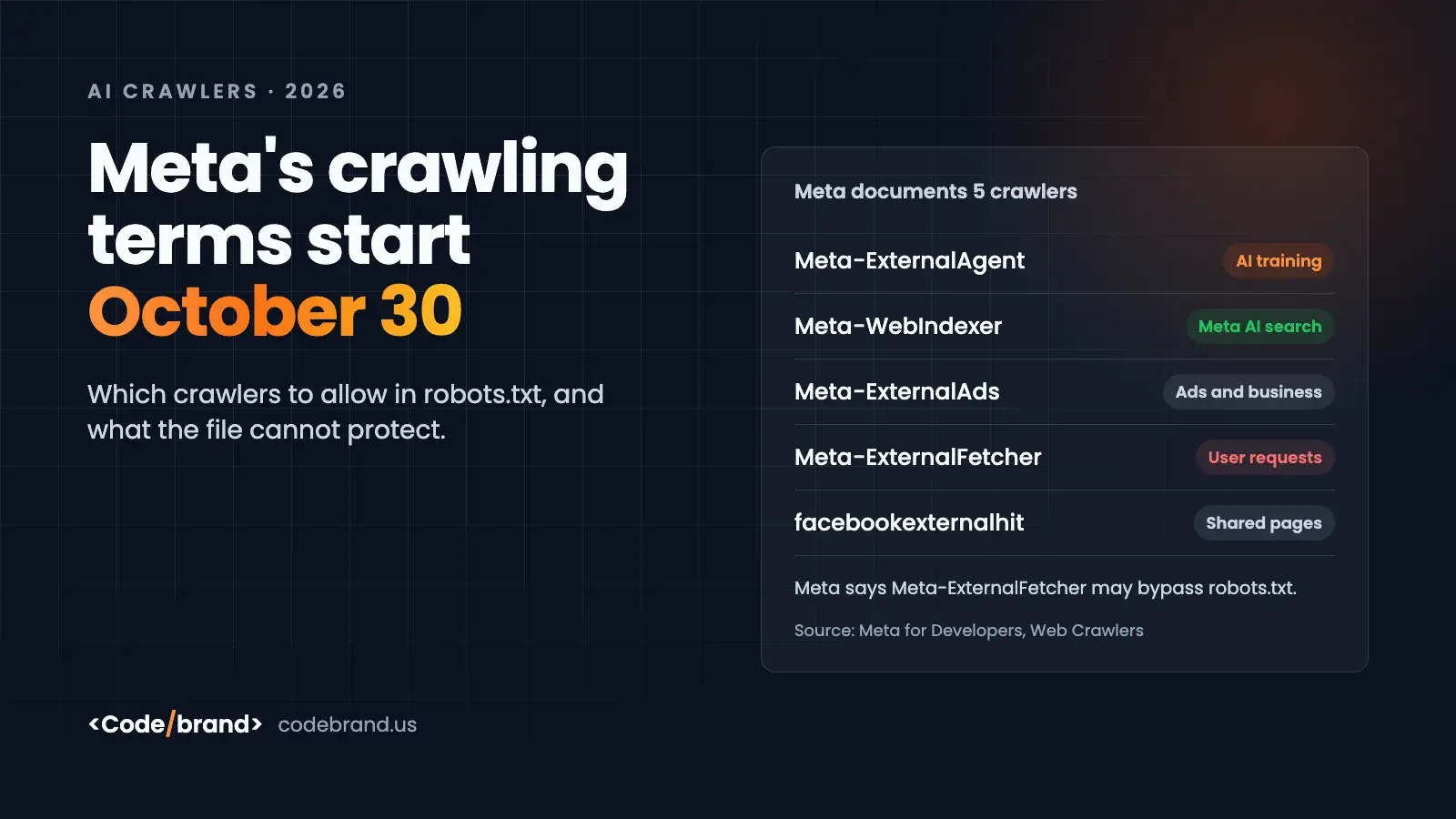
Meta Crawler and robots.txt: What to Set for AI Bots
Meta's new Commercial Terms cover crawling business websites. Learn which Meta, OpenAI, Google and Anthropic crawlers to allow or block in robots.txt.
Why Contractors Can't Scale: The Construction Marketing Gap
Why most construction companies fail to scale: referrals alone stall growth. See the data on SEO, website speed, reviews and AI, plus a roadmap for contractors.
Want this done for your business?
Tell us the goal and the budget you have. You get a fixed-price proposal within 24 hours.